On Monday, March 23, members of the Georgetown community gathered for a conversation on one of the most pressing questions in American politics today: what happens to democracy when affordability collapses and institutions fail to respond?
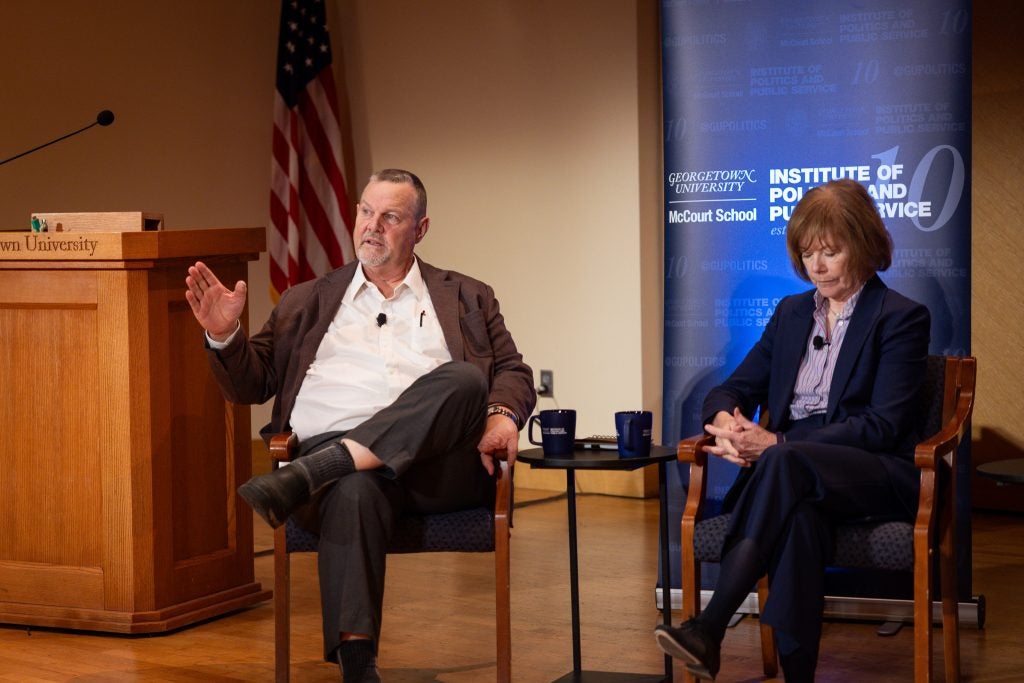
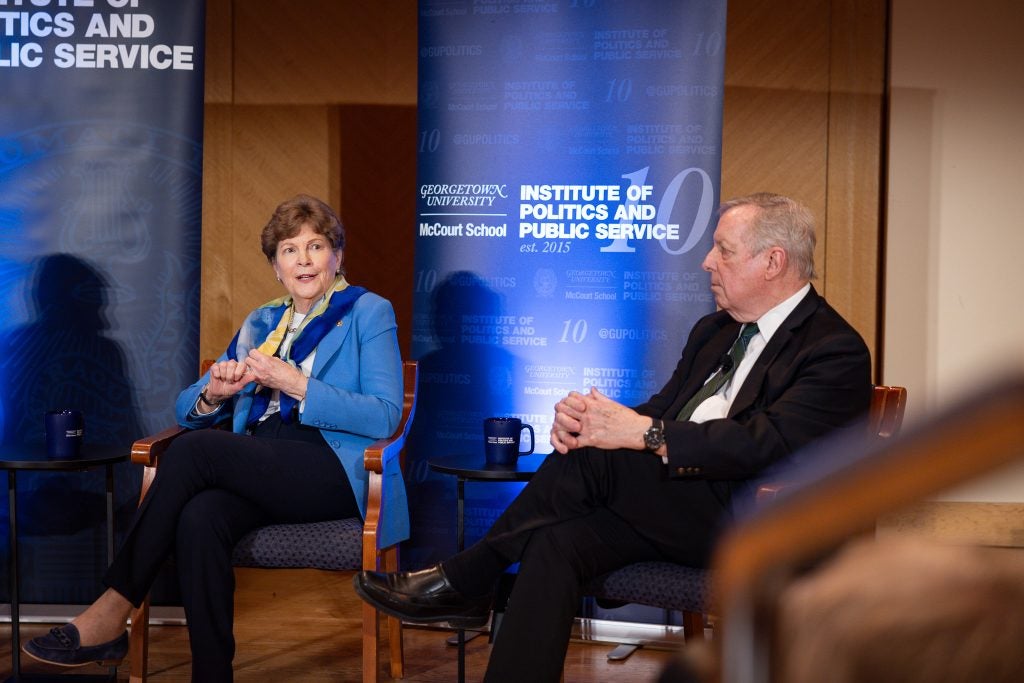
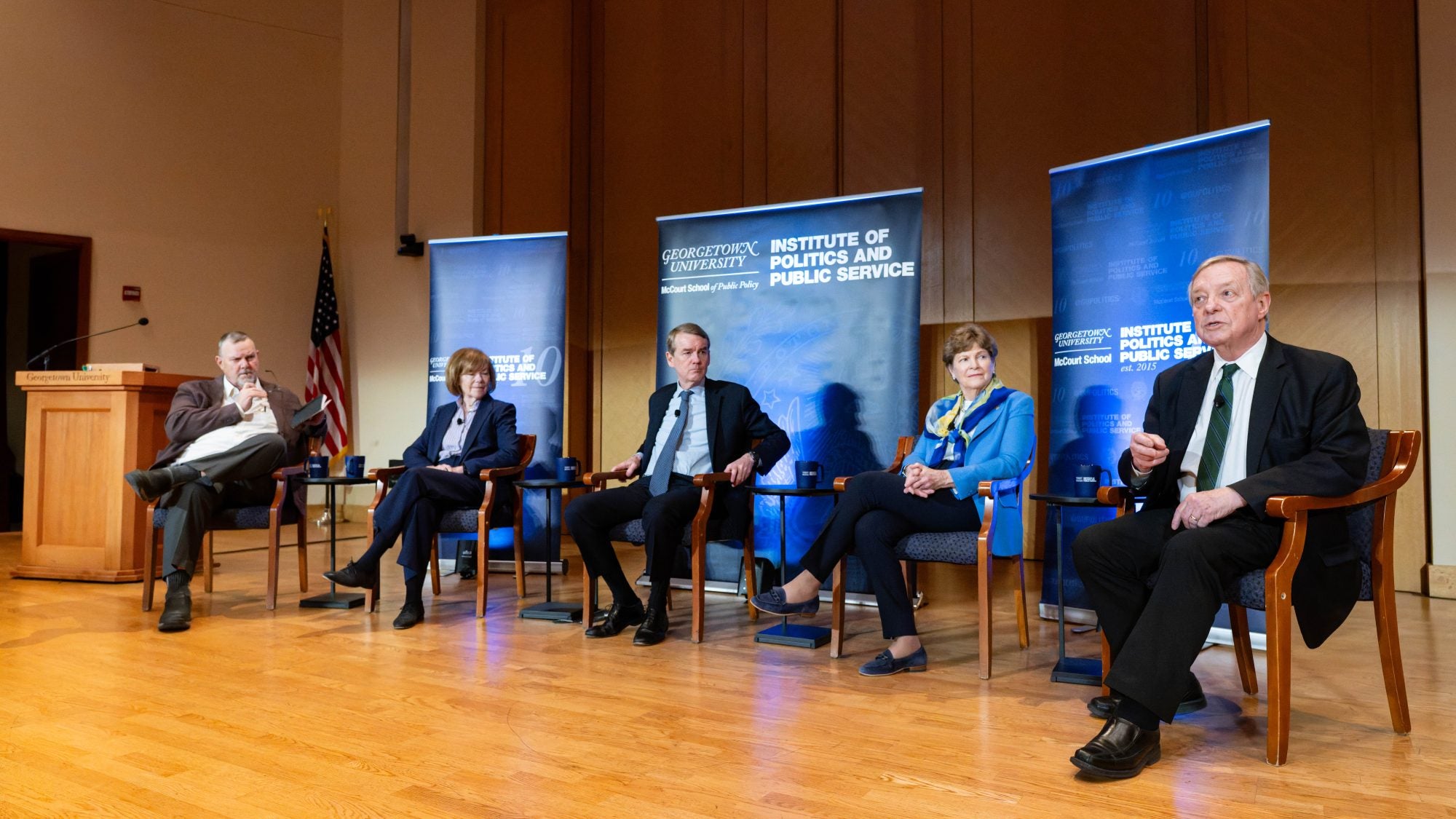
Hosted at Georgetown in Lohrfink Auditorium, former Senator Jon Tester, a Spring 2026 GU Politics Fellow, moderated a panel featuring U.S. Senators Senators Michael Bennet (D-CO), Dick Durbin (D-IL) (SFS’66, L’69), Jeanne Shaheen (D-NH) and Tina Smith (D-MN). The panel covered the intersection of economic insecurity, executive power, and accountability and what that means for the future of democracy and the Democratic Party.
From the outset, the conversation centered on a shared diagnosis that the cost of living crisis is at the forefront of shaping everyday life. Sen. Bennet pointed to the reality of teachers relying on food banks to feed their families, calling it “totally intolerable” and evidence of an economy that no longer works for working people. He described a country where “we have teachers […] going to a food bank to feed their own family,” asking the audience to consider whether such a reality would have been imaginable even a few decades ago. Sen. Durbin reinforced this point, noting that in many parts of the country, families are now spending up to “ 60% of their income on housing,” turning what was once basic stability into something increasingly out of reach.
The discussion quickly moved beyond symptoms to structural causes. Bennet argued that the American economy is increasingly “rigged” in favor of corporations and the ultra-wealthy, pointing to the outsized role of billionaire political contributions and corporate ownership of housing. He said “the Democratic Party has to break up with billionaires,” and economic inequality is a reflection of the party. Bennet extended this argument, pushing for more ambitious structural solutions like universal healthcare and firm housing affordability standards, insisting that incremental fixes are no longer enough to meet the scale of the crisis.
Yet affordability was only one layer of a broader concern. The panel repeatedly returned to the erosion of institutional balance, particularly the expansion of executive power and the weakening of congressional oversight. Sen. Shaheen described Congress as increasingly unable, or unwilling, to fulfill its constitutional role, creating what she called a “power vacuum” in which authority shifts toward the presidency. She asked whether Americans “see the Senate doing the kind of oversight that we should be doing,” and answered: “you don’t see any of that.” Instead, she argued, power “just continues to go towards the executive,” accelerating a long-term erosion of checks and balances.
Foreign policy further added another layer to these concerns. Bennet criticized recent decisions, particularly regarding Iran and Ukraine, as lacking sufficient consultation, cautioning that “there are unintended consequences” when major actions are taken without broader input.
Sen. Smith tied these institutional failures directly to the future of democracy and the Democratic party. For Sen. Smith, the issue is the Democratic Party’s inability to offer a compelling vision for the affordability crisis. As she put it, the party “did not have a compelling vision about how we were going to solve” it. Without that clarity, she argued, people begin to lose faith in the system, especially when it feels like no matter how hard they work, they can’t get ahead. In that vacuum, figures like Trump are able to step in and present themselves as the only solution. The real challenge, she suggested, is not just opposing one person, but rebuilding a broad majority that can actually deliver results and restore trust in democratic institutions.
Throughout the conversation, students pressed the panel on what could realistically change. Questions on the Senate filibuster, money in politics, and voter access emphasized a deeper frustration within the electorate which asks if the system is structurally blocked, how can reform ever happen? Sen. Shaheen argued that the filibuster has “outlived its usefulness,” noting that it was never part of the original constitutional design and now contributes to legislative paralysis.
Despite these critiques, the panel repeatedly returned to the role of public engagement and the necessity to engage with democracy in order to fix it. The senators urged students to demand accountability and participate actively in civic life. In closing, the senators struck a tone that was both candid and cautiously hopeful. While acknowledging structural challenges, they rejected the idea that democratic decline is inevitable. Instead, they framed the current moment as a test: if the public is willing to confront and work to reshape the system itself.
This article was written by Anushka Tadikonda (SFS’29).
Watch the full recording below. View more photos here.