A Conversation with U.S. Ambassador to the United Nations Mike Waltz
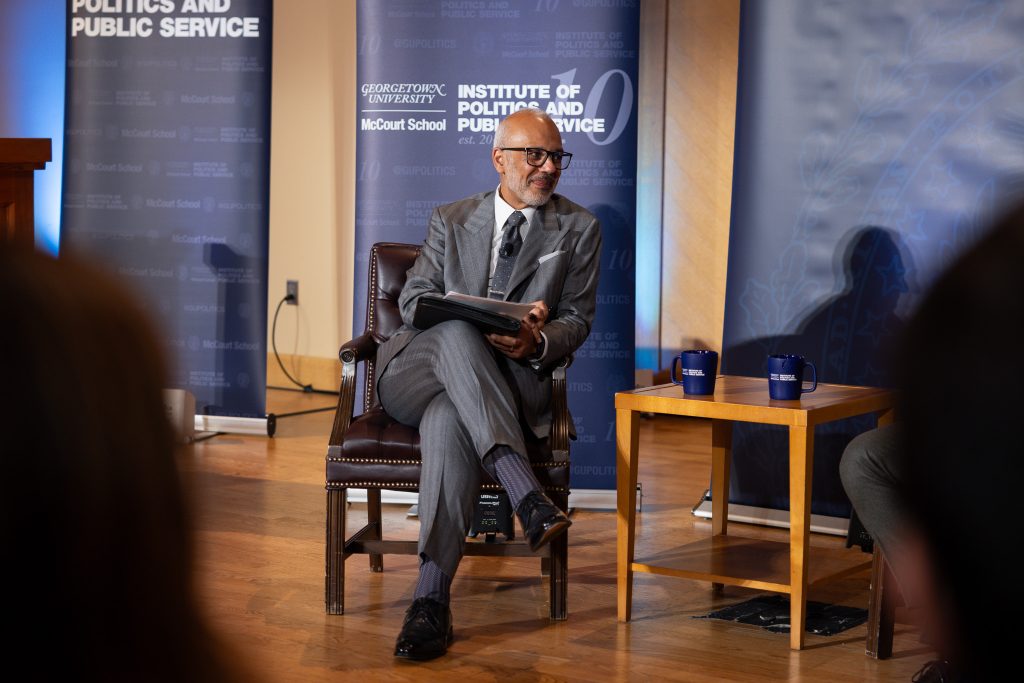
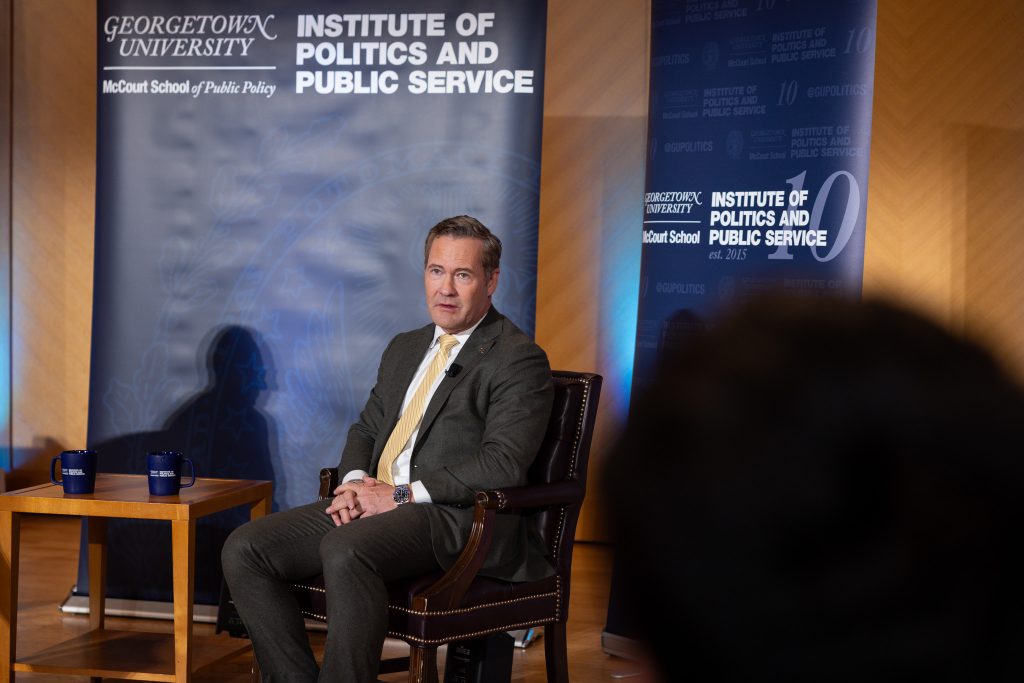
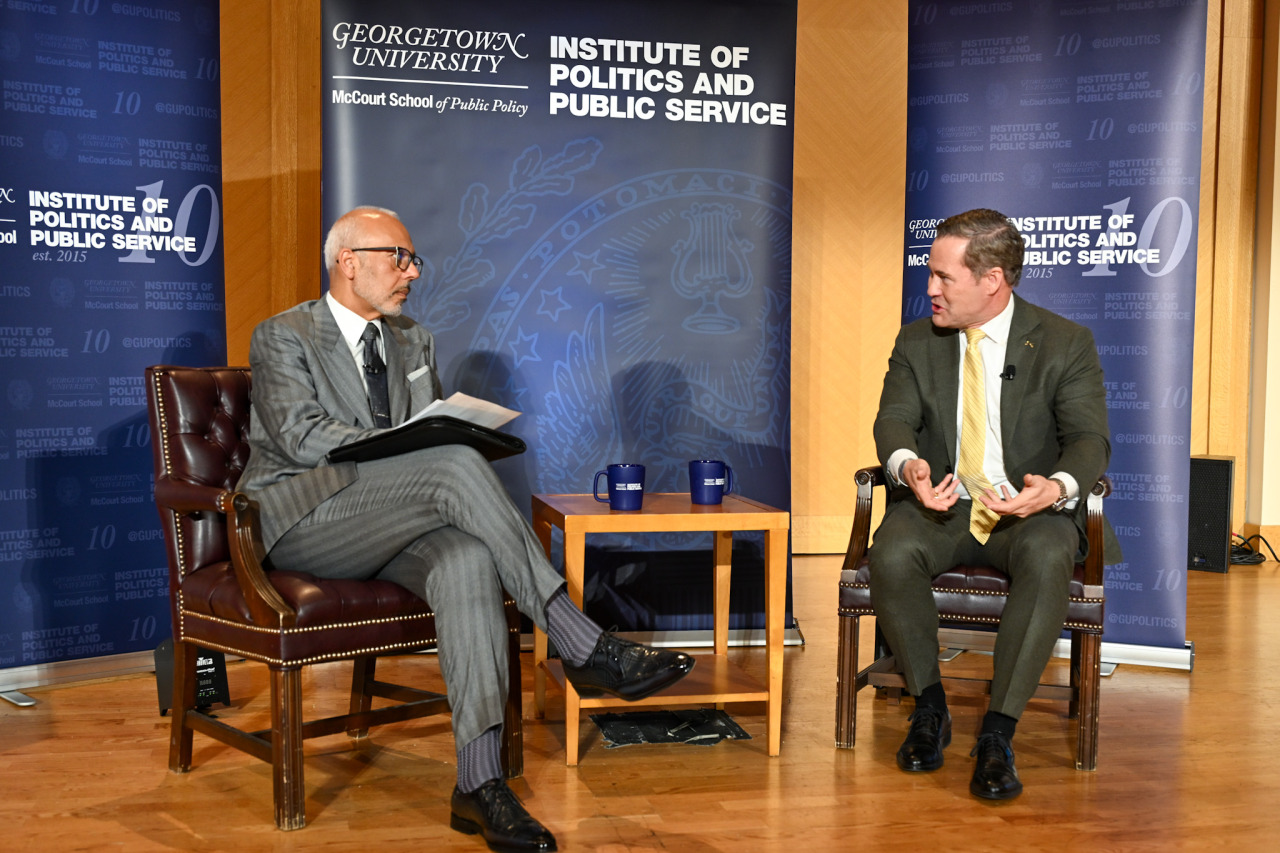
On Monday, April 14th, members of the Georgetown community packed the Lorfink Auditorium for a conversation on some of the most pressing questions in international affairs: what is the future of American diplomacy, and what role do international institutions play in a rapidly fracturing world?
Georgetown’s Institute of Politics and Public Service hosted the conversation with Mike Waltz, the United States Ambassador to the United Nations and former National Security Advisor, moderated by Mo Elleithee (SFS’94), Executive Director of GU Politics and a proud SFS alum.
Elleithee opened by asking Ambassador Waltz to lay out the organizing principle behind the administration’s foreign policy, the “Dunroe Doctrine.” Waltz described it as a reassertion of American leadership in the Western Hemisphere, driven by lessons from COVID-19 about supply chain dependency, the dangers of over-reliance on China, and years of neglect in Latin America and the Arctic. “It’s really about reasserting that leadership,” Waltz said, “diplomatically, militarily, and certainly economically.”
The conversation turned to the United Nations. Waltz acknowledged the President’s frustrations with the institution but was clear about his own charge. “He’s been critical, but he’s also said there’s tremendous potential, and my charge from him is to help us realize that potential.” He pointed to the UN’s budget quadrupling over the last 25 years with little corresponding increase in global peace, and highlighted ongoing conflicts, particularly in Sudan, that the world has largely forgotten. “How do we get the UN reengaged in resolving wars, preventing wars, and keeping the peace?” he asked.
This shifted the conversation to the financial state of the UN. Waltz was blunt, noting that the institution is on an “absolutely unsustainable financial path” with the United States paying more than 180 other countries combined. He drew a parallel to 1999, when Senators Jesse Helms and Joe Biden withheld U.S. funding to force reforms, suggesting a similar approach may again be necessary.
The discussion also took up the question of China’s growing influence at a time when American humanitarian efforts have been scaled back. Waltz pushed back on the framing, arguing that merging USAID into the State Department was about coherence and effectiveness, not retreat, pointing out that the United Kingdom and Australia had made similar consolidations. On competition with China at the UN, he said “these are our values in terms of freedom of assembly, freedom of the press, freedom of religion, that we want to espouse on the world stage.” He noted that the U.S. is aggressively running candidates for leadership positions in UN bodies like the World Intellectual Property Organization, encouraging Georgetown students to consider careers in those organizations as part of that effort.
After the initial conversation, the event moved to a Q&A portion. Students asked about the situation in Iran, which Waltz described as the defining challenge of the moment. He was unequivocal that Iran cannot be allowed to obtain a nuclear weapon, a position backed not just by the United States, but by UN Security Council resolutions going back over two decades. He addressed the ongoing naval blockade in the Strait of Hormuz, arguing that no country can be allowed to decide “who the winners and losers are in the global economy” by shutting down international shipping lanes.
When asked whether the Security Council still matters after Russia and China vetoed the Hormuz resolution, Waltz was clear. “We do need it,” he said, explaining that for many countries, a UN Security
Council authorization is the legal basis for contributing troops to international stabilization efforts. He pointed to Article 51 of the UN Charter, which the U.S. has invoked as the basis for its actions in self-defense, acknowledging it “will be debated by international lawyers right here at your law school for quite some time.”
Students also asked about Lebanon and Israel, the US-India relationship, religious freedom at the UN, and the ongoing capacity of the Houthis following recent U.S. military operations. On Lebanon, Waltz pointed to the historic first direct meeting between the Lebanese and Israeli ambassadors at the State Department earlier that day as a sign of progress, offering a reflection on the nature of diplomacy itself: “What I’ve learned as a diplomat: sometimes just having the meeting is a huge accomplishment. Sometimes getting two sides in a room that, for their own domestic or historic reasons, wouldn’t even sit together, is a huge first step.”
He closed with a message for students considering careers in public service. “Find ways to serve. You don’t have to join government to serve your communities. Serve your neighbors, find ways to volunteer. There’s no greater gift than giving back. We don’t always get things right, we often get things wrong. Be part of the solution.”
This article was written by Anushka Tadikonda (SFS’29).
Watch the full recording below. View more photos here.